
Table of Contents
Magnetic Cable Channel vs Under-Desk Tray: Biomechanical Cable Routing
Managing cables across a motorized sit-stand desk requires choosing between vertical leg concealment and horizontal bulk capacity. While an open-wire under-desk tray gathers heavy transformer bricks beneath the worktop, a magnetic cable channel routes lines down the structural steel frame without requiring mounting screws or permanent adhesive strips.
When evaluating a magnetic cable channel vs under-desk tray configuration, the primary decision factor is whether your routing challenge is power distribution storage or dynamic vertical line drops. Below is the structural and thermal analysis to determine which system fits your workstation load.
| Metric | Magnetic Cable Channel | Under-Desk Cable Tray |
|---|---|---|
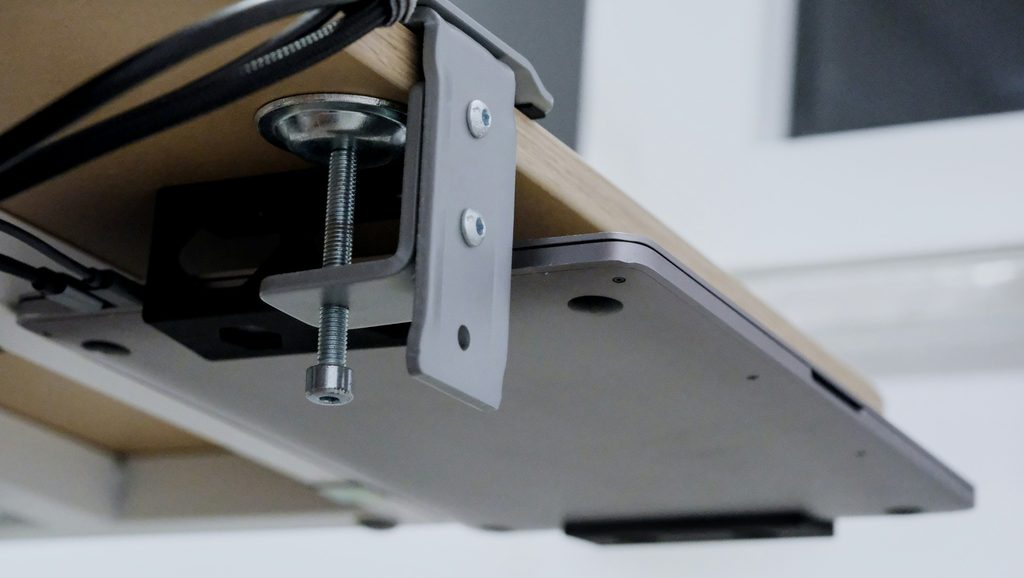
| Mounting Method | Neodymium magnetic adhesion to steel columns | Wood screws or heavy-duty C-clamp brackets |
| Primary Routing Axis | Vertical leg columns (floor-to-desktop drop) | Horizontal under-desktop distribution |
| Weight Capacity | Light to Moderate (cables and small cords) | High (heavy AC power bricks and power strips) |
| Frame Compatibility | Ferromagnetic steel frames only (not aluminum) | Universal (attaches directly to desktop substrate) |
Magnetic Adhesion Mechanics and Peel-Off Thresholds
When evaluating a magnetic cable channel vs under-desk tray, magnetic channels rely on high-grade neodymium (NdFeB) magnetic strips integrated along the back of the raceway. This allows instant tool-free attachment to telescoping lifting columns. However, maintaining reliable adhesion requires understanding shear versus pull force.
When the desk moves vertically, bundled cords exert downward gravitational pull. If the total mass of the enclosed cables exceeds the magnetic shear resistance, the channel will slip downward or peel off the leg. To prevent magnetic failure, maintain adequate vertical drop slack as detailed in our guide to standing desk cable management rules.
Thermal Dissipation and Power Brick Containment
High-wattage GaN chargers and laptop power supplies produce significant ambient heat under sustained workloads. Enclosing multiple high-draw transformers inside a compact, solid-wall channel can trap thermal energy and cause early safety throttling.
For high-power setups, an open wire under-desk cable management tray provides passive convective cooling that keeps power bricks within safe operating limits. Use the open tray underneath the desk surface to house transformers, and reserve the sleek magnetic channel solely for low-voltage display and peripheral cords traversing down the steel leg.
High-Voltage Isolation and Dynamic Travel
Running high-voltage 120V/240V power lines directly adjacent to high-speed DisplayPort or USB-C data cables inside an unshielded channel can trigger data transmission errors due to electromagnetic interference. For optimal performance, run your primary AC power trunk along one leg column and your shielded data cables along the opposite leg channel.
Executing a hybrid setup with a magnetic cable channel vs under-desk tray guarantees both high payload storage beneath the desk and clean, snag-free wire travel during height transitions.
Balancing a magnetic cable channel vs under-desk tray configuration guarantees maximum dynamic slack and total cord protection across every sit-to-stand transition.
Steel Frame Compatibility and Adhesive Shear Calibration
Before deploying a magnetic cable channel vs under-desk tray setup, desk frame alloy composition dictates mounting feasibility. Magnetic raceways require high-ferromagnetic cold-rolled steel columns to maintain contact grip. Extruded aluminum frames, common on premium minimalist motorized desks, lack ferromagnetic properties and cannot anchor magnetic channels without secondary adhesive metal strike plates. For aluminum or composite lifting legs, an undermount tray paired with dynamic articulated vertebrae remains the standard mechanical approach.
Furthermore, calibrate cable bundle mass against dynamic elevation acceleration. When motorized columns start or stop abruptly, inertial acceleration multiplies downward cord mass. Fastening your bundled leads to an under-desk cable tray with heavy-duty hook-and-loop straps absorbs dynamic shock loads, ensuring magnetic channel segments on the legs guide lightweight secondary runs without risking sudden shear detachment.
Executing a hybrid setup with a magnetic cable channel vs under-desk tray guarantees both high payload storage beneath the desk and clean, snag-free wire travel during height transitions. Balancing a magnetic cable channel vs under-desk tray configuration guarantees maximum dynamic slack and total cord protection across every sit-to-stand transition.