
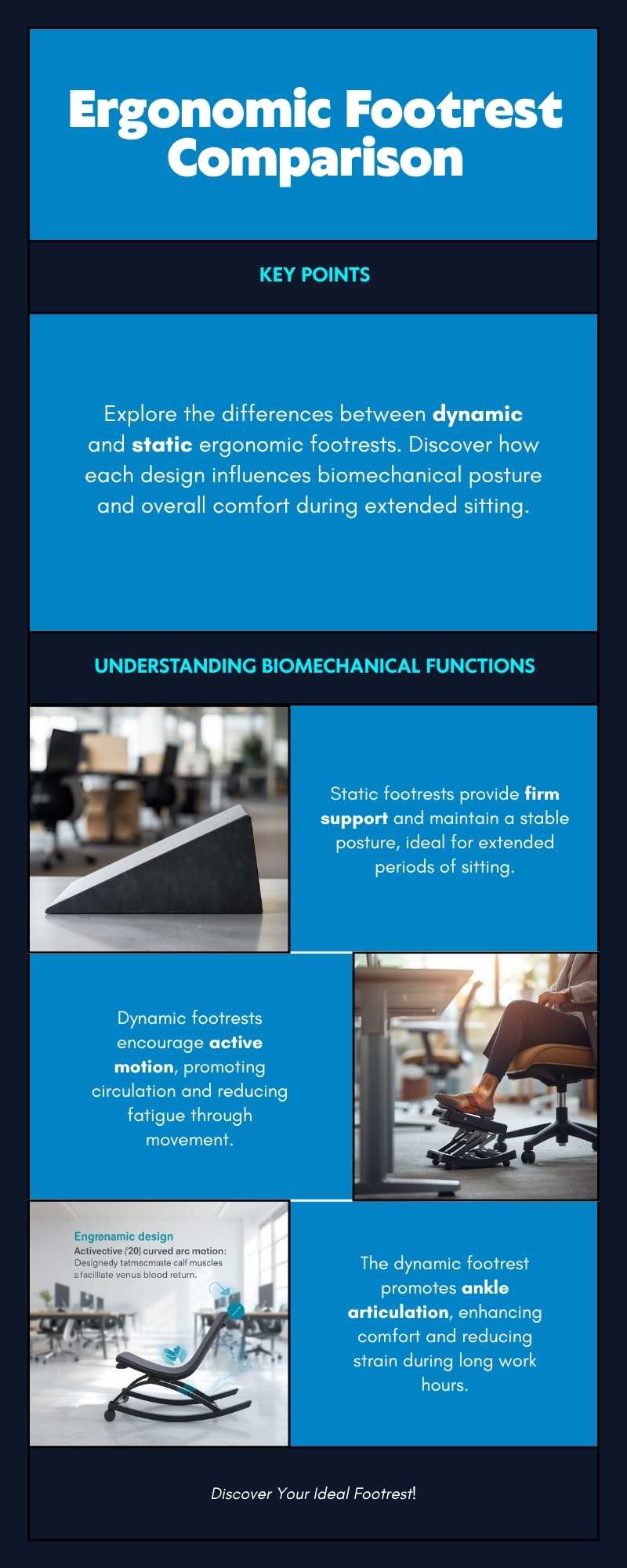
Evaluating a dynamic vs static ergonomic footrest setup is essential for maintaining healthy pelvic alignment and preventing lower-extremity circulatory pooling during long hours at an office desk. While fixed wedge footrests stabilize the feet at a set incline to reduce hamstring strain, dynamic rocking footrests encourage micro-movements across the ankle joint, activating the calf muscle pump and restoring venous return throughout sedentary work sessions.
Biomechanical Summary: Active Calf Pump vs Static Pelvic Tilt
Sitting with unsupported feet forces the thighs against the front waterfall edge of your chair, compressing the popliteal artery. In a dynamic vs static ergonomic footrest comparison, static platforms provide rigid structural anchoring to decompress lumbar discs, whereas dynamic curved rockers stimulate blood flow, reducing ankle edema and preventing leg lethargy without disrupting keyboard focus.
Table of Contents
Biomechanical Analysis: Dynamic vs Static Ergonomic Footrest Mechanics
To determine how a dynamic vs static ergonomic footrest improves seated posture, occupational ergonomists evaluate four primary physiological stress vectors across the lower kinetic chain:
- Calf Muscle Pump (Venous Hemodynamics): Static feet allow blood to pool in the lower extremities, whereas oscillating motion actively compresses soleus and gastrocnemius veins, assisting return circulation.
- Pelvic Rotation & Lumbar Lordosis: Raising the knees slightly above hip level (100° to 105° hip angle) opens the sacral angle and prevents posterior pelvic tilt, eliminating lower back hunching.
- Popliteal Nerve Clearance: Eliminating thigh contact pressure along the chair pan prevents sciatic tingling and femoral vascular compression.
- Ankle Articulation Range: Dynamic curved rockers allow continuous dorsiflexion and plantar flexion (±15° to ±25°), lubricating the talocrural joint during deep focus tasks.
Dynamic vs Static Ergonomic Footrest: 5 Rigorous Posture Tests
| Ergonomic Parameter | Static Wedge Footrest (Fixed Incline) | Dynamic Rocking Footrest (Curved / Pivot) |
|---|---|---|
| Venous Blood Circulation | Moderate (Relies entirely on static height) | High (Active calf pumping with movement) |
| Pelvic Stability Rating | High (Firm structural anchor for spine) | Moderate (Continuous micro-adjustments) |
| Joint Angle Adaptability | Fixed 15° to 30° Single Plane | Dynamic ±20° Fluid Arc Motion |
| Under-Desk Footprint | Compact (Low-profile high-density foam) | Wider Base (Requires clear radius clearance) |
| Best Workstation Pairing | Standard Fixed-Height Seated Desks | Sit-to-Stand Desks & Drafting Stools |
Our workspace ergonomics evaluations demonstrate that while static high-density foam wedges excel at anchoring the pelvis for focused deep work, integrating a dynamic vs static ergonomic footrest platform prevents stiffness during multi-hour technical sessions.
Kinetic Chain Integration: Footrests and Desk Stability
Lower-extremity support functions as the foundation of your full workstation posture. When optimizing chair elevation and foot position, consider how your overall workstation hardware behaves under active load:
- Frame Stability & Legroom: Dynamic rocking platforms require clear under-desk travel space. Before installing under-desk accessories, review our guide to standing desk stability to ensure motor crossbars and leg columns do not obstruct your feet.
- Vibration Isolation: Shifting weight dynamically on an articulating rocker can transfer energy into lightweight frames. Review our field tests on standing desk wobble fixes to secure leveling glides and prevent monitor shaking while moving your feet.
- Under-Desk Cable Clearance: Ensure floor-level wiring is routed properly with an under-desk cable management tray so rocking foot pedals never pinch power cables or snag peripheral cords.
- Ergonomic Seating Guidelines: All workstation seating configurations should conform with official OSHA computer workstation seating guidelines to preserve neutral spine posture and healthy circulation.
Active Sitting vs Static Anchoring in Long Technical Shifts
Evaluating an office setup around a dynamic vs static ergonomic footrest highlights how active sitting reduces muscle fatigue. A static footrest sets the pelvic angle and isolates the legs. However, locking the feet into a static wedge for eight hours straight causes muscular tightness across the Achilles tendons and plantar fascia. An active rocker encourages intermittent ankle pumps, which prevent micro-edema in your ankles and sustain alert focus throughout demanding programming sprints.
Kinetic Energy Dissipation and Floor Friction Dynamics
Beyond ankle angles and calf pumps, evaluating a dynamic vs static ergonomic footrest requires assessing under-desk traction across various floor substrates. When seated on low-pile commercial carpet, high-density rubberized bottom glides prevent static wedges from migrating forward under sustained heel pressure. Conversely, dynamic oscillating rockers generate lateral kinetic shear. Without textured silicone base grips, repetitive rocking movements cause lightweight plastic frames to slide out of reach, forcing users to repeatedly pull the unit backward with their heels and interrupting typing flow.
To preserve consistent kinetic alignment on hardwood or laminate surfaces, select footrest platforms equipped with weighted steel pivot axles and broad anti-skid rubber feet. Heavy-duty pivot hardware absorbs shifting center-of-gravity forces without marring floor finishes or squeaking during quiet work hours. Securing a grounded, non-slip base ensures your lower kinetic chain remains relaxed, allowing micro-movements to stimulate blood circulation effortlessly while you maintain deep focus.
Ergonomic Hardware Recommendation: Adjustable Dynamic Footrest
For workstation setups requiring both firm elevation and active circulation support, an adjustable dynamic rocking footrest provides selectable tilt angles and free-floating motion to relieve lumbar fatigue.
Frequently Asked Questions: Dynamic vs Static Ergonomic Footrest Setups
Can I use an ergonomic footrest with an adjustable standing desk?
Yes. When lowered to sitting height, standing desks are often set higher than standard 29-inch surfaces to accommodate tall keyboard trays or armrests. A dynamic vs static ergonomic footrest bridges this height gap, ensuring your feet stay grounded without dangling.
Which footrest type is better for chronic lower back pain?
If your lower back discomfort stems from lumbar flexion or slouching, a static wedge footrest provides the firm baseline needed to keep your pelvis aligned against the chair backrest. If pain stems from spinal stiffness and lack of movement, a dynamic rocking footrest promotes subtle core activation that prevents joint lock.
Do dynamic rocking footrests distract from typing focus?
No. The rocking motion is subconscious and operates similarly to an under-desk balance board. Evaluating a dynamic vs static ergonomic footrest setup reveals that gentle rocking actually increases alertness by promoting blood flow back to the brain during monotonous typing blocks.
Published by J.D Desmond — Lead Technical Hardware Contributor at Vortex Momentum.