
Maintaining a neutral typing posture during long coding or writing sessions requires critical wrist support. Choosing between a wooden wrist rest vs foam support involves balancing soft joint cushioning against firm skeletal palm alignment, directly impacting carpal tunnel compression, tendon fatigue, and wrist mobility.
Table of Contents
Wooden Wrist Rest vs Foam: Biomechanics and Nerve Compression
The primary clinical distinction in any wooden wrist rest vs foam evaluation centers on contact pressure distribution across the carpal tunnel. When typing, resting the sensitive underside of your wrist against a surface can compress the median nerve.
Soft memory foam allows the heel of your hand to sink deeply. While this feels plush initially, excessive sinkage can anchor your wrists in place. This restricts natural forearm glide across wide keyboard arrays, forcing horizontal finger reach through extreme ulnar deviation. Furthermore, deep depression can direct upward pressure into the transverse carpal ligament, counteracting ergonomic benefits.
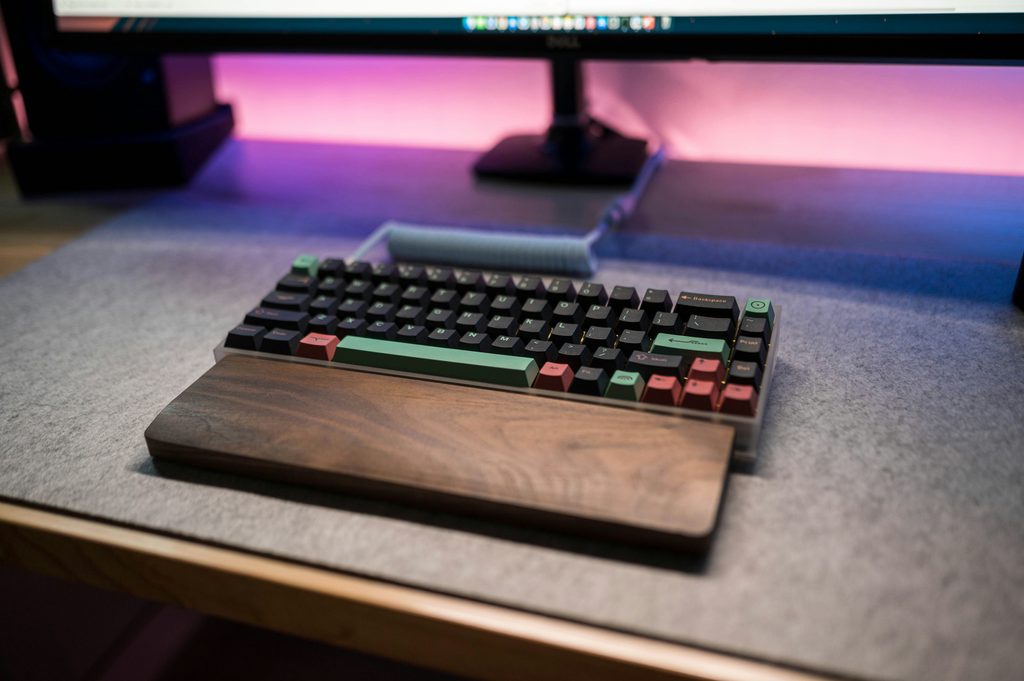
Solid wood rests (such as walnut or oak) provide an unyielding planar platform. They act as a palm rest rather than a wrist cushion. By elevating the heel of the palm to match the keyboard’s front bezel height, hardwood keeps the carpal tunnel floating without direct contact pressure, adhering strictly to OSHA ergonomic keyboard positioning standards.
Comparison Table
| Ergonomic Feature | Memory Foam / Gel Rest | Solid Hardwood (Walnut / Oak) |
| Primary Support Type | Dynamic soft cushioning | Static planar palm elevation |
| Carpal Tunnel Clearance | Prone to contact pressure under body weight | Keeps median nerve floating |
| Forearm Lateral Glide | High friction / skin drag | Smooth, unrestricted repositioning |
| Thermal Dissipation | Traps heat, causes sweat buildup | Neutral room-temperature dissipation |
| Durability & Lifespan | 6–18 months (degrades and flakes) | Decades (with periodic oil treatment) |
| Hygiene & Maintenance | Absorbs sweat, difficult to sanitize | Non-porous surface, wipes clean instantly |
Thermal Buildup and Skin Hygiene Over Long Sessions
Memory foam wrist rests rely on polyurethane cellular structures that trap ambient body heat. During prolonged typing sessions, this creates localized sweat accumulation between the skin and the fabric or faux leather covering. Over time, moisture penetration breaks down the foam matrix, causing structural collapse and harboring skin bacteria.
Hardwood palm rests maintain passive temperature neutrality. Solid walnut, ash, or oak does not compress or absorb sweat. A quick wipe with a microfiber cloth removes oils, preventing the grime and odor common to aged foam pads.
Typing Style Compatibility: High-Profile vs. Low-Profile Keyboards
Your mechanical switch choice and typing technique dictate which material performs best:
- Floating Typists (High-Speed Touch Typists): Solid wood is superior. High-speed typists only drop their hands during pauses. Wood serves as a rigid resting ledge that maintains wrist extension angles without creating wrist anchor fatigue.
- Anchored Typists & Casual Gamers: Dense, firm memory foam offers short-term relief if you apply downward forearm pressure during use. However, soft foam promotes poor wrist extension over four or more hours of continuous typing.
- Keyboard Front Bezel Height: For high-profile mechanical keyboards (OEM, SA, or Cherry profiles with tall front edges), wood provides the exact millimeter-matched height needed to eliminate upward wrist bending.
Long-Term Durability and Setup Integration
Foam rests degrade through daily abrasion, stitching tears, and foam flattening, often requiring replacement within one to two years. Solid hardwood wrist rests provide structural permanence. When paired with rubber non-slip feet, they stay planted on your desk mat without sliding.
To optimize ergonomics across your entire workstation, match your wrist height with a properly calibrated desk frame. For tips on setting stable, deflection-free work surfaces, consult our guide on standing desk dynamic load and height stability.
Verdict: Which Wrist Rest Should You Choose?
Choose a Foam Wrist Rest if: When finalizing your wooden wrist rest vs foam decision, your daily typing habits and keyboard bezel profile determine the winner. You prioritize immediate soft cushioning over clinical ergonomics, use low-profile chiclet keyboards, or want a lightweight, portable pad for travel.
Choose a Wooden Wrist Rest if: You use a mechanical keyboard with a tall front edge, type for long stretches, want maximum median nerve clearance, or prefer a clean, premium desktop look that lasts for years.