
Standing for extended periods at a motorized desk is widely press.Yet, standing completely stationary on a hard floor introduces a new mechanical failure: venous pooling in the calves, sustained compression across the lumbar facet joints, and acute tightness along the plantar fascia.
To combat this static fatigue, two primary floor interventions dominate workstation setups: anti-fatigue mats and active balance boards. When setting up an active workstation, deciding between a standing desk mat vs balance board comes down to passive joint relief versus continuous muscular engagement.
Below, we break down the kinetic chain impact, biomechanical trade-offs, cognitive focus implications, and our technical spec comparison to help you choose the right base for your standing desk setup.
Before deciding which accessory fits your office space, review our empirical data in our standing desk balance board vs anti fatigue mat 5 ergonomic tests to see how each impacts joint load and typing accuracy. This standing desk mat vs balance board evaluation highlights how static cushioning differs from dynamic multi-axis tilt.
Table of Contents
This balance board vs anti-fatigue mat spec breakdown highlights the trade-off between passive cushion and active articulation.
Standing Desk Mat vs Balance Board: Biomechanical Comparison
Both surfaces aim to reduce lower-body discomfort, but they achieve this through completely opposite physical mechanisms:cribed as the antidote to sedentary screen work. Yet, standing completely stationary on a hard floor introduces a new mechanical failure: venous pooling in the calves, sustained compression across the lumbar facet joints, and acute tightness along the plantar fascia.
To combat this static fatigue, two primary floor interventions dominate workstation setups: anti-fatigue mats and active balance boards. Choosing between a balance board vs anti-fatigue mat is not just an aesthetic decision—it is a choice between passive cushioning and dynamic neuromuscular activation.
Below, we break down the kinetic chain impact, biomechanical trade-offs, cognitive focus implications, and our technical spec comparison to help you choose the right base for your standing setup.
Standing Desk Mat vs Balance Board: 5 Key Comparison Rules
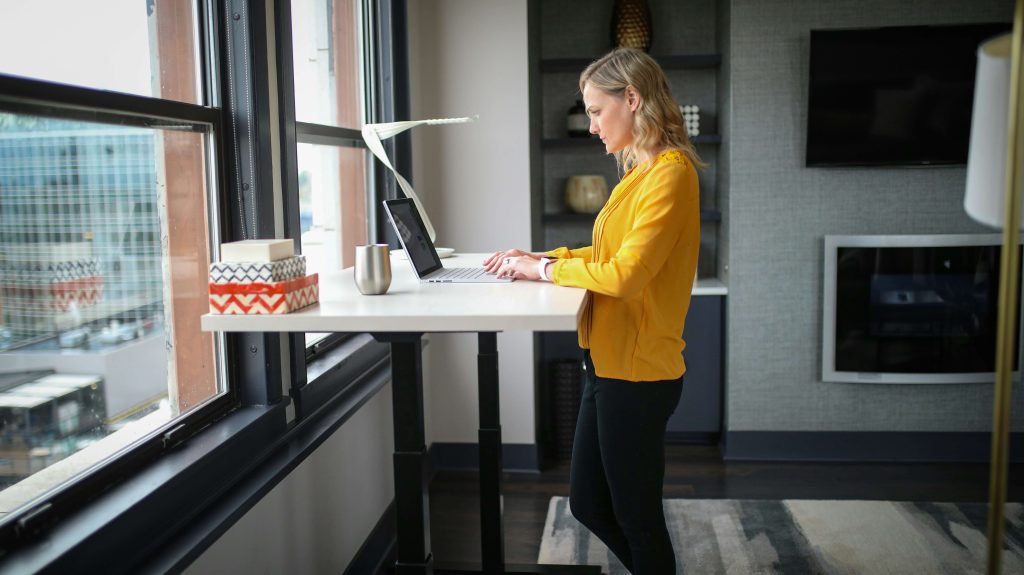
Both surfaces aim to reduce lower-body discomfort, but they achieve this through completely opposite physical mechanisms:
ANTI-FATIGUE MAT (Passive Cushioning)
[Floor] -> [High-Density Polyurethane] -> [Even Plantar Vault Load]
• Mechanism: Micro-compression & point-pressure distribution
• Motion Profile: Static / Micro-shifts

BALANCE BOARD (Dynamic Instability)
[Floor] -> [Fulcrum / Curvature Axis] -> [Continuous Ankle Articulation]
• Mechanism: Neuromuscular activation & dynamic dorsiflexion
• Motion Profile: 8° to 15° Multidirectional Tilt Arc
1. Anti-Fatigue Mats: Hydrostatic Load Distribution
In any balance board vs anti-fatigue mat analysis, static absorption serves as the baseline for lower-limb relief
Anti-fatigue mats rely on high-density polyurethane or closed-cell foam cores. When your body weight compresses the mat, the material provides an elastic counter-force that disperses pressure evenly across the heel, lateral arch, and metatarsals.
Because the surface yields slightly under load, it encourages unconscious micro-contractions in the intrinsic foot muscles and calf wall, preventing venous blood from pooling in the lower extremities
2. Balance Boards: Continuous Proprioceptive Feedback
Balance boards replace passive foam with a rigid wooden or composite deck mounted over a curved rocker base or central fulcrum dome. Rather than absorbing pressure, the board introduces controlled instability.
To remain upright, your neuromuscular system continuously fires stabilizer muscles across the ankles, peroneals, calves, hamstrings, and deep abdominal core. This continuous engagement keeps the kinetic chain mobile and prevents the static joint locking common with standard standing.
Technical Spec Breakdown
| Biomechanical Metric | High-Density Anti-Fatigue Mat | Curvature Rocker Balance Board | Active 360° Wobble Dome |
| Primary Material | 100% Polyurethane / NBR Foam | Solid Hardwood / Rubber Base | Molded Polymer / Steel Ball |
| Motion Axis | Static (Compression only) | Single-axis side-to-side (Linear) | Omnidirectional 360° rotation |
| Tilt Arc Range | 0° (Flat compression) | 8° to 12° linear arc | Up to 18° multi-axis swing |
| Core Muscle Activation | Low (Passive support) | Medium (Stabilizer engagement) | High (Continuous recruitment) |
| Cognitive Interference | Zero (High typing precision) | Low (Adaptable during typing) | Moderate (Better for calls) |
| Footwear Compatibility | Socks, Barefoot, Flat shoes | Flat sneakers / Grip socks | Athletic footwear required |
| Max Standing Duration | 60–90 Continuous minutes | 20–45 Minute active rotations | 15–30 Minute active intervals |
Cognitive Focus: The Typing vs Meeting Matrix
A major trade-off in the balance board vs anti-fatigue mat debate is cognitive load. Fine-motor tasks like rapid coding, precision drafting, and complex debugging require upper-limb stillness:
High-Precision Work (Coding, Writing, CAD Design)
- Winner: Anti-Fatigue Mat
- When writing code or editing text, excessive upper-body sway introduces micro-vibrations into the wrists and shoulders. An anti-fatigue mat offers a grounded, predictable platform that eliminates foot soreness without disturbing wrist alignment or monitor eye lines.
Low-Precision / High-Energy Tasks (Meetings, Brainstorming, Code Review)
- Winner: Balance Board
- During sprint retrospectives, video calls, or passive reading, a balance board maintains alert mental engagement. The gentle rocking rhythm keeps circulation active, increases calorie expenditure, and combats post-lunch lethargy.
Balance Board vs Anti-Fatigue Mat: When to Choose a Mat
To choose the right standing desk mat vs balance board setup, evaluate your daily standing duration and footwear habits.
When weighing a balance board vs anti-fatigue mat for deep-focus engineering workflows, static support often takes priority.
- You Struggle with Slumping or Locked Knees: Standing on a rigid floor often leads to locking your knees and anterior pelvic tilt (hyper-extended lower back). A rocker board forces soft knees and active pelvic engagement.
- You Prefer Short, Active Standing Bursts: Alternating 30 minutes of seated focused work with 20 minutes of dynamic standing on a rocker board keeps your metabolic rate elevated throughout the day.
- You Want to Build Ankle Strength and Proprioception: The dynamic tilt reinforces lateral ankle stability and calf strength during passive working hours.
The Hybrid Recommendation
In the balance board vs anti-fatigue mat debate, you don’t need to treat this as an exclusive decision.
- Mornings (Deep Work / High Output): Stand on a high-density anti-fatigue mat or sit in an adjusted ergonomic chair.
- Early Afternoon (Combating the Slump): Swap to the balance board for 20- to 30-minute intervals during reading, reviewing, or audio calls to elevate blood flow.
- Transition Alignment: Pair your base with an adjustable foot rest when seated to maintain an optimal 95° to 105° hip angle throughout the workday.
Frequently Asked Questions
Here are the most common questions when deciding on a balance board vs anti-fatigue mat for your workstation.
Can you use a balance board all day at a standing desk?
No. Using a balance board for an entire 8-hour workday will cause neuromuscular fatigue and may lead to poor compensation posture in the hips and lower back. Limit active balance board sessions to 20–45 minute rotations.
Do anti-fatigue mats actually reduce back pain?
Yes. Quality high-density mats absorb downward pressure and stimulate subtle calf muscle pumping, which prevents venous pooling and reduces static compressive stress across the lumbar spine.
Can I use a balance board vs anti-fatigue mat barefoot?
Can I use a balance board vs anti-fatigue mat barefoot?. Ultimately, testing a standing desk mat vs balance board in your daily routine will ensure your lower back and joints stay supported.