
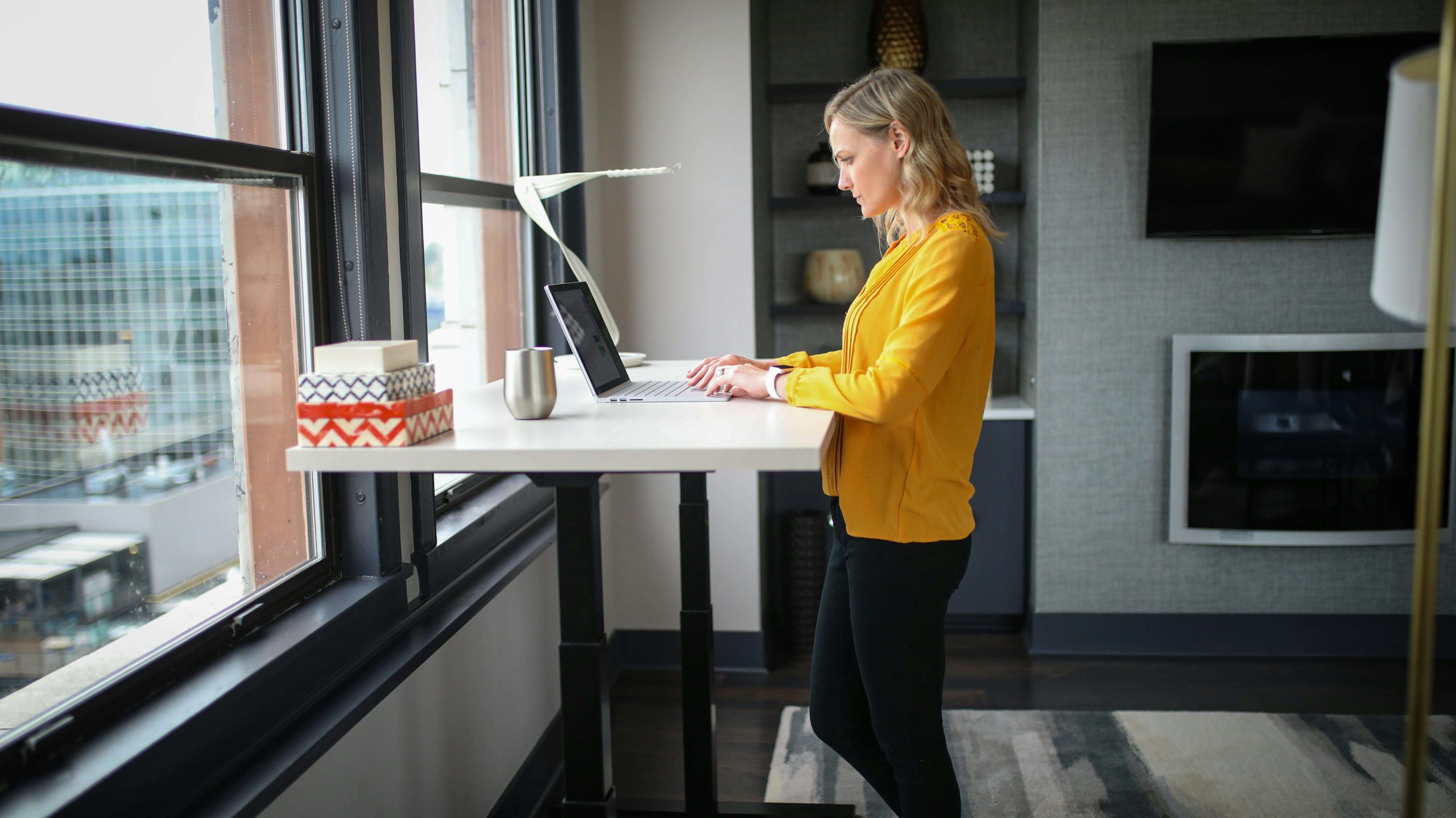
Using a standard standing desk height calculator often introduces a dangerous biomechanical assumption: treating human beings as rigid, uniform sticks standing barefoot on concrete.
If you have ever adjusted an electric standing desk to match a standard online chart—only to end up with throbbing trapezius muscles, wrist dorsiflexion, or tingling fingers within 30 minutes—the problem isn’t your posture. The calculator itself is fundamentally flawed.
Table of Contents
1. The Missing Variable: Standing Surfaces and Footwear Shift
Standard calculators pull pure geometric height from basic percentile tables. However, practically nobody works barefoot on a subfloor. In a real-world home office, your elbow datum height is shifted upward by dynamic workstation surfaces:
- Standard Athletic Sneakers: Add +1.0 inch (2.5 cm) of heel-to-forefoot stack height.
- High-Density Anti-Fatigue Foam Mats: Compress under load, adding roughly +0.75 inches (1.9 cm) of elevation.
- Ergonomic Balance Rockers & Wobble Boards: Raise your stance by +2.0 to +2.5 inches (5.0 to 6.4 cm) while introducing active sagittal micro-movements.
Using a standard desk height calculator without factoring in footwear stack height guarantees wrist fatigue within an hour.
Stepping onto a 2.5-inch rocker board without adjusting your standing desk height calculator inputs causes severe wrist extension. To keep your wrists in neutral alignment (0° to 15° bend), your desk elevation must scale precisely with your footwear.
2. The Single-Motor vs. Dual-Motor Elevation Ceiling
Traditional desk tables rarely warn users about the mechanical limits of entry-level frames. Most single-motor standing desks use 2-stage telescoping legs that max out around 42 to 43 inches.
If you stand 6’0″ or taller and use an anti-fatigue mat, your resting olecranon (elbow) datum demands an elevation of at least 44 to 45 inches. When an entry-level frame bottoms out below your target height, you are forced into involuntary spinal slouching and shoulder shrugging.
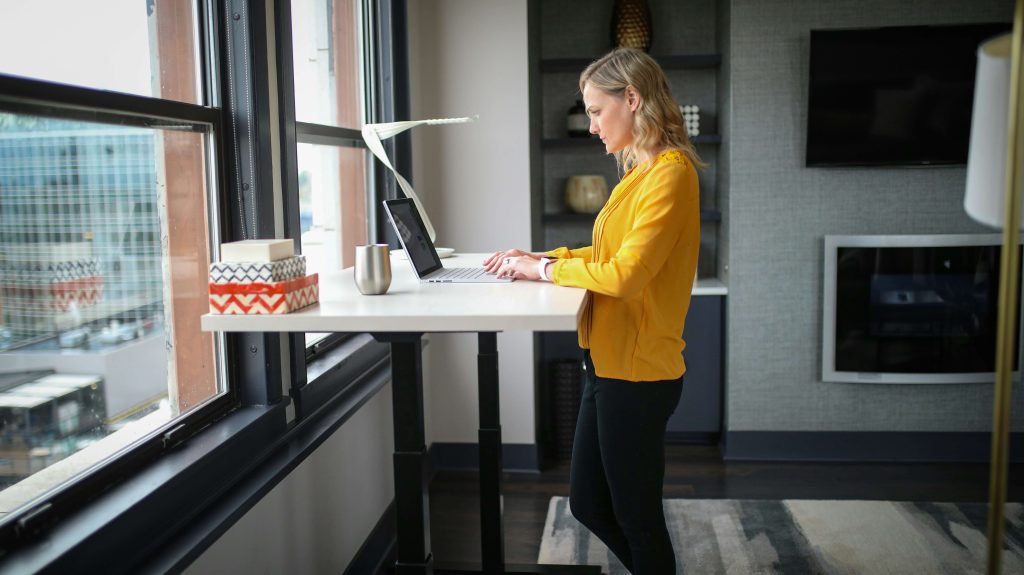
3. Setup Lab Standing Desk Height Calculator: Solving the Biomechanical Equation
To eliminate manual guesswork and prevent repetitive strain injuries (RSI), we engineered a dedicated solution adhering to ANSI/BIFMA G1-2017 ergonomic standards.
Calculate your custom multi-point elevation, monitor sightline declination, and seated popliteal seat depth using our interactive tool: Launch the Free Workspace Setup Lab Desk Height Calculator.
Dynamic Monitor Arm Gas-Spring Travel Calibration
Setting your target values with a standing desk height calculator is only half the ergonomic battle; display focal geometry must track your posture changes dynamically. When transitioning from seated to standing, your torso elongates, and your natural resting gaze declination shifts between 10 and 20 degrees. Relying on a fixed stock display stand forces you to accept compromised vertical eye alignment at one end of the elevation spectrum.
To eliminate cervical spine hyperextension, calibrate your monitor on an articulating gas-spring arm with at least 13 inches of independent vertical travel. When you run your baseline values through our desk height calculator, position the top bezel of your display exactly level with your standing horizontal sightline. This downward viewing cone relieves constant isometric strain on your upper trapezius while preventing dry eye syndrome caused by excessive upward ocular exposure.
Popliteal Angle Calibration and Lower Limb Circulation
When relying on standard standing desk height calculator tables, users frequently overlook the transition back to seated posture. Setting desk elevation without calibrating seat pan depth creates severe popliteal artery constriction behind the knee crease. When an office chair cushion presses firmly against the posterior calf, femoral venous return is impeded, resulting in lower extremity blood pooling and afternoon lethargy.
To eliminate circulatory pinch points, maintain at least two to three fingers of open clearance between the front edge of the seat cushion and the back of your knees. Calibrating your chair height so feet rest completely flat on the floor—or on an elevated angled footrest—preserves an open 90° to 100° knee angle. This structural baseline ensures that when you adjust your work surface, your seated posture remains fully supported without lumbar collapse.
Deploying a verified standing desk height calculator ensures both seated and standing phases of your workday function as a cohesive kinetic system. By balancing desk elevation against foot position, you maintain natural spinal curvature and eliminate compensatory shoulder shrugging throughout extended shifts.
Sagittal Pelvic Tilt and Kinetic Chain Spinal Decompression
Biomechanical alignment requires evaluating your standing desk height calculator values as an integrated kinetic chain rather than isolated joint coordinates. When adjusting desktop elevation, minor errors of just one to two inches force involuntary pelvic tilting. If a desk surface sits too high, your forearms act as cantilevers that roll your shoulders inward, flattening the natural lordotic curve of the lumbar spine and triggering chronic trapezius spasms.
Conversely, positioning your work surface too low forces anterior head carriage and cervical spine extension. Calibrating your setup with our verified standing desk height calculator maintains a neutral pelvis, relaxed abdominal engagement, and unobstructed thoracic breathing. This dynamic balance distributes body mass evenly through your feet and standing accessories, preventing localized disc compression during prolonged focus sessions.
Load Distribution Across Anti-Fatigue Core Substrates
Deploying a standing desk height calculator accurately requires accounting for how your supportive accessories compress under sustained body weight. Closed-cell polyurethane foam mats compress roughly 30% to 45% under resting heel pressure over consecutive hours. This subtle deflection lowers your functional standing plane by up to half an inch compared to your static barefoot baseline.
If you fail to adjust your work surface for this continuous mechanical settling, your wrists gradually creep into progressive dorsiflexion as the morning unfolds. Calibrating your desktop height to your compressed afternoon stance rather than initial morning contact protects your forearm tendons and eliminates micro-adjustments throughout your shifts.
Motor Heat Dissipation and Continuous Cycle Limits
Beyond static tabletop elevation, routine daily adjustments test linear actuator thermal capacity. Operating electric dual-motor frames through rapid successive height changes generates motor winding resistance. When you run baseline values through our standing desk height calculator, commit your primary seated and standing targets to digital memory presets. Automated positioning minimizes continuous motor runtime, prevents thermal overload shutdowns, and extends the mechanical lifespan of your lifting columns.
4. Recommended 3-Stage Daily Setup Cadence
Once you run your measurements through our standing desk height calculator, implement this structured sit-stand cadence:
- Phase 1 (Morning Deep Work): 45 minutes seated with feet flat and popliteal space uncompressed.
- Phase 2 (Mid-Day Kinetic Stance): 30 minutes standing on an anti-fatigue mat with elbows at an open 90°–100° angle.
- Phase 3 (Post-Lunch Active Shift): 20 minutes standing on a balance board to promote venous calf return and blood circulation.
Long-Term Kinematic Verification Protocol
Biomechanical adaptations change as muscles fatigue over an eight-hour shift. To guarantee lasting physical relief, re-evaluate your workstation dimensions every quarter. Micro-settling in your task chair foam, gradual sole compression in your work shoes, or switching anti-fatigue mats alters your baseline elbow and gaze geometry by half an inch or more. Running fresh measurements through our standing desk height calculator ensures your joints remain neutrally aligned season after season.